Table of Contents
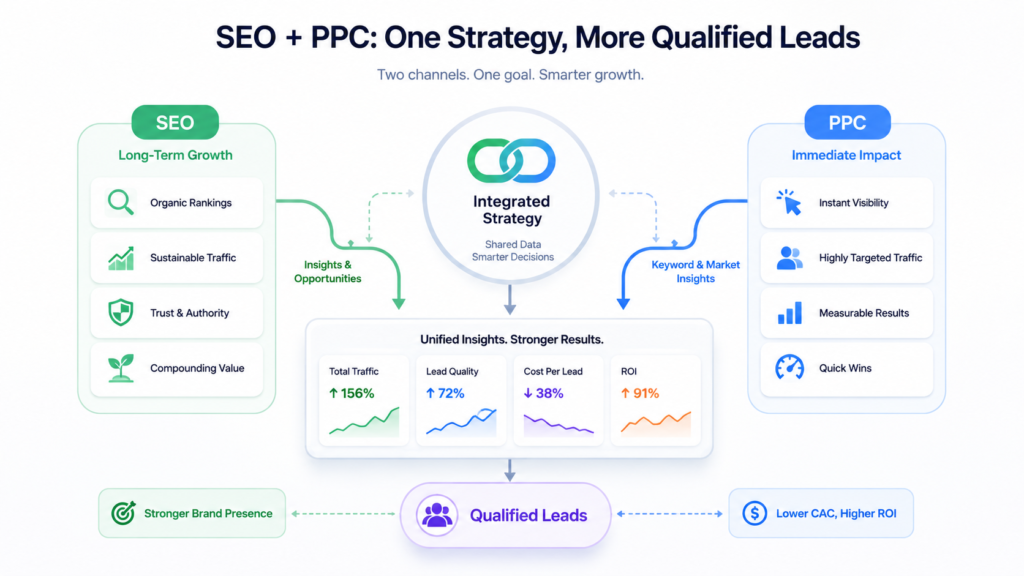
In the majority of organizations, both SEO and PPC marketing are seen as two different departments sharing the same marketing budget. One team chases rankings. The other team chases clicks. They rarely talk to each other, and the data from one almost never informs the other.
That’s a missed opportunity — and honestly, it’s the single biggest gap I see when businesses try to generate leads online.
When you run SEO and PPC marketing as one connected strategy instead of two competing ones, you get the best of both worlds: the immediate visibility of paid ads and the long-term, compounding value of organic search. In this post, I’ll walk you through why this combination works, a real example of it in action, the framework I use with clients, and the mistakes that trip most businesses up.
Why SEO and PPC Marketing Work Better Together
SEO and PPC tackle different issues at different times.
PPC places you where people are searching currently. Bid, get served, get clicks – usually within hours after campaign setup.
SEO creates exposure which snowballs. It’s slower to work but once you start ranking, you aren’t paying per click anymore.
In isolation, each method is flawed in its way. With PPC, you’ll have to pay an increasingly large sum to acquire customers if it’s your only traffic source. Also, no more payment means no more visits. With SEO, you might be forced to wait for several months before getting a substantial exposure, especially in a competitive niche.
But used in conjunction, each makes up for weaknesses of another. PPC helps till SEO reaches a certain level of effectiveness. After that, you rely less on paid traffic sources.
A Real Example: Doubling Qualified Leads in 3 Months
I helped a local company increase customer inquiries. It had been receiving a certain amount of organic visits due to its SEO efforts, but it needed something extra.
PPC and SEO were done simultaneously. The former produced instant results, while the latter continued working in the background. Yet the greatest benefit didn’t come from doing both but from the information PPC yielded that could be used in the SEO efforts. Specifically, we found out which paid keywords converted customers and used this knowledge in SEO optimization.
The results, within about three months:
| Metric | Before | After ~3 Months |
| Qualified leads/month | 10–15 | 20–30 |
| Lead source dependency | Mostly PPC | Blended SEO + PPC |
| Cost per lead (PPC) | Higher | Gradually decreasing |
As organic traffic picked up, the business relied less on paid clicks to hit its lead targets, which brought the overall cost per lead down. That’s the compounding effect of an integrated SEO and PPC marketing strategy — it doesn’t just add two channels together, it makes each one more efficient.
The Biggest Mistake Businesses Make
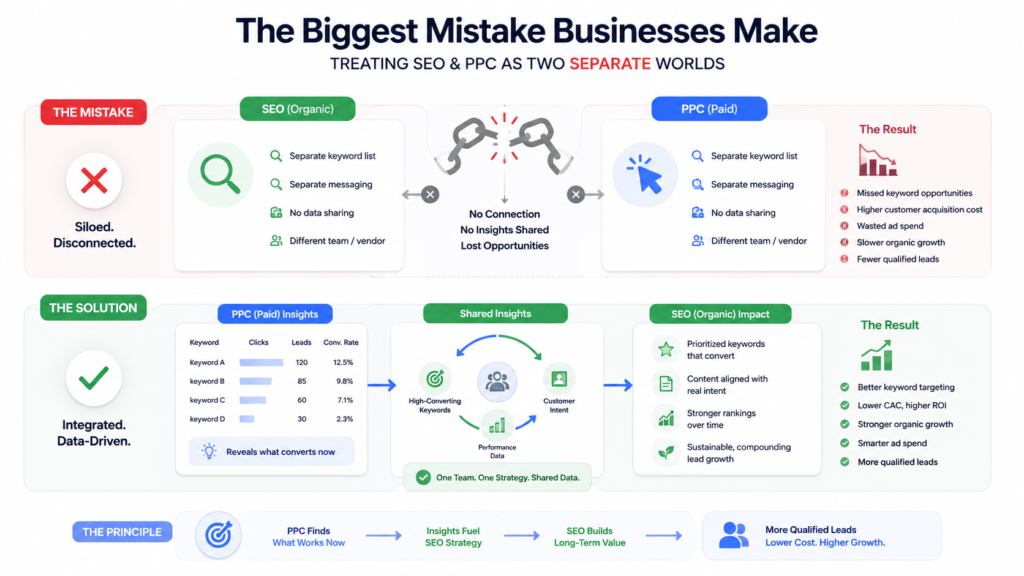
The biggest mistake I find companies making is viewing SEO and PPC campaigns as two entirely separate processes – separate keyword lists, separate messaging, no shared information, sometimes even separate vendors who don’t communicate with each other.
The problem with this approach is that you’re missing out on key insights. With PPC, you’ll get immediate insights into which keywords generate actual conversions rather than just visitors. If these insights are never taken into account when developing the SEO campaign, you’re essentially working in the dark.
Bottom line: the keywords that work for generating leads via PPC need to be prioritized within your SEO content strategy as well.
A Practical Framework for Integrating SEO and PPC
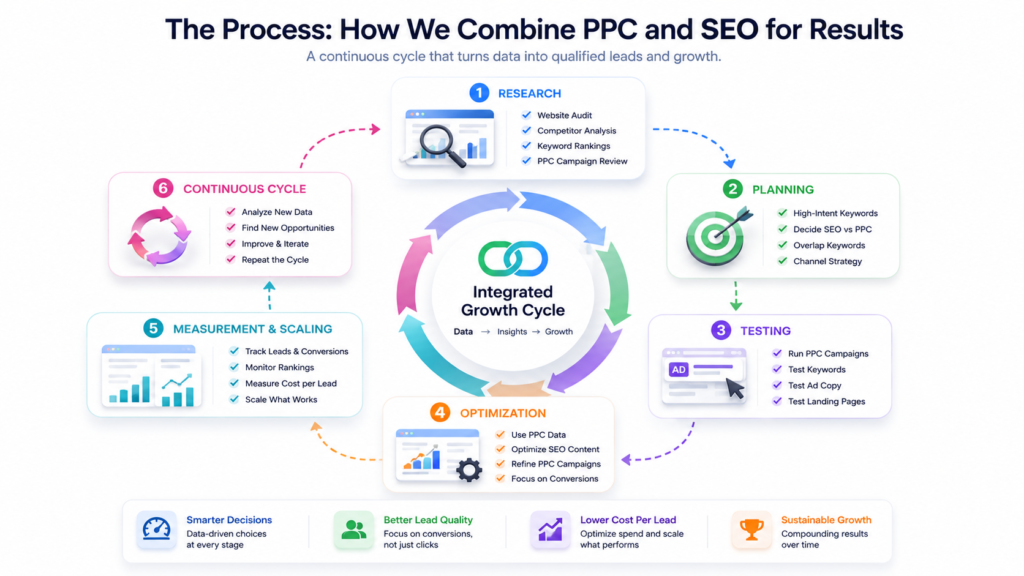
The process of combining PPC and SEO marketing for my clients consists of the following steps:
Research – Auditing my client’s website, competition, keywords’ ranking, and current PPC campaigns helps to get an idea about their position.
Planning – I determine the keywords of higher intent, decide which ones will go to SEO, PPC, and which ones require targeting in both channels.
Testing – Running the PPC campaigns allows for testing keywords, advertisement copy, and landing pages fast since you can receive answers immediately through paid traffic rather than waiting for organic rankings.
Optimization – The data from PPC campaigns is used to optimize the SEO content and refine the paid campaigns according to which leads generate conversions rather than clicks.
Measurement and scaling – Measuring and monitoring leads, conversions, ranking positions, and cost per lead allows focusing on those channels (or keywords) that generate the most profitable results.
This is not an occasional task. This is a cycle – each phase feeds into the next one and you go round and round it with the coming information.
What to Prioritize on a Limited Budget
Not all companies have the ability to perform a complete SEO and PPC marketing strategy simultaneously, but that’s all right. If your budget doesn’t allow such an approach, follow this plan:
- Do you have patience? Then focus on SEO first. It will take time to grow organic search traffic, but then you’ll be able to save money on PPC ads.
- Need leads now? Start with a narrow PPC campaign, using a small number of high-intent keywords only. At the same time, develop SEO strategy slowly and steadily.
Frequently Asked Questions
Do I need a huge budget for integrating SEO and PPC? No. You could go for a smaller PPC campaign that focuses only on a few selected high-intent keywords while you develop your SEO slowly. It is always about starting small.
How long will it take to get the results after integration of SEO and PPC marketing? The results of a PPC marketing campaign come very fast – literally in a few hours. On the other hand, SEO may take more time, but in our example, the combination resulted in a rise in the number of qualified leads in about three months.
What’s the main benefit of SEO and PPC integration over using only one? The benefits of both SEO and PPC are combined together plus SEO can be improved through the data obtained through PPC marketing.
Conclusion
SEO and PPC marketing don’t have to conflict with one another in terms of budget allocation or effort; when used together in tandem, SEO and PPC marketing complement each other. PPC brings in leads before SEO has gained traction, and SEO helps lessen the dependence on paid traffic in the long run. The key is to use PPC data in order to target more effectively through SEO.
Begin with researching and testing through PPC campaigns, then optimize using the data collected, and expand those strategies that work.