Table of Contents
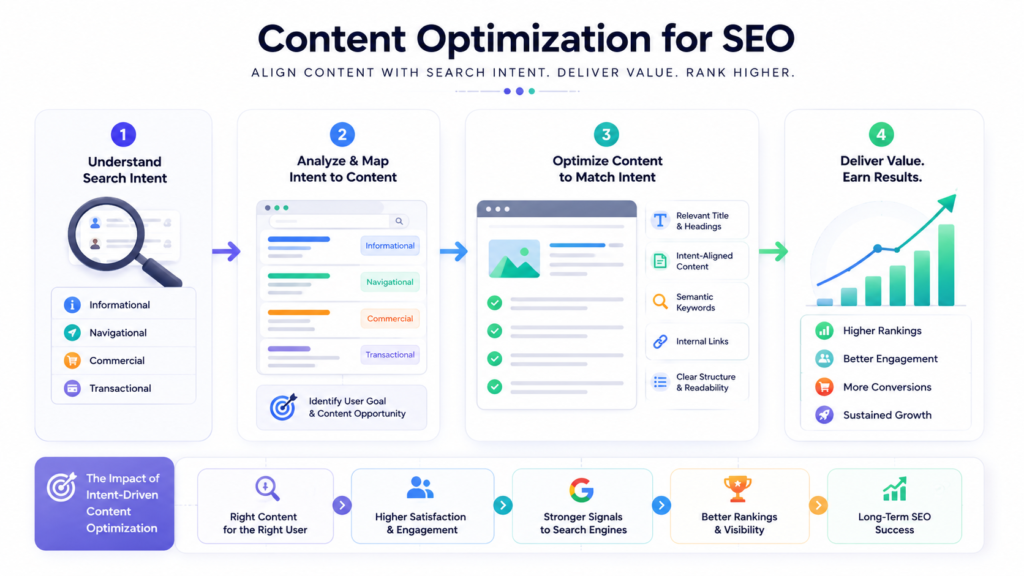
If you have ever worked seriously on content optimization for SEO , chances are that you encountered a situation when a page meets all requirements of the technical SEO and still does not appear on the list. The page may even appear there, but visitors do not linger on it.
In 9 out of 10 cases, it will not be the problem of technical SEO. It will be the problem of search intent.
One of the most frequent mistakes that people make, and one that I personally used to make, is the fact that instead of focusing on the question behind the keyword, one focuses solely on the keyword. One places it right in the spot where the checklist tells him to put it, but forgets about finding out what a person, who enters the query, actually needs. This is precisely why the intent has become the basis of content optimization for SEO.
What Search Intent Actually Means
Search intent is what drives a search, not just the keywords used in the search. Someone searching for “content optimization for SEO” could be looking for:
- A definition and description (informational)
- Steps that they can follow to achieve it (informational, more detailed)
- Some software or tool that would enable them to do it (transactional)
- A website for a certain company (navigational)
Same keyword, four entirely different intents are used in content optimization for SEO. And there’s nothing you can do to salvage your content if you are catering to the wrong different needs. If your content answers the wrong one, no amount of keyword placement will save it.
The Four Types of Search Intent
| Intent Type | The Goal of the Searcher | Sample Query | Optimal Content Format |
| Informational | In order to gain knowledge about something | “What is search intent” | Blog post/guide |
| Navigational | In order to go to a certain page/site | “Google Search Console login” | Direct landing page |
| Commercial | In order to weigh options before purchasing | “best SEO tools 2026” | Comparison post/listicle |
| Transactional | In order to do something right away | “hire SEO content writer” | Service/product page |
Aligning your content with the proper column in the above table is the one thing that can make all the difference.
Why Keyword-First Writing Falls Short
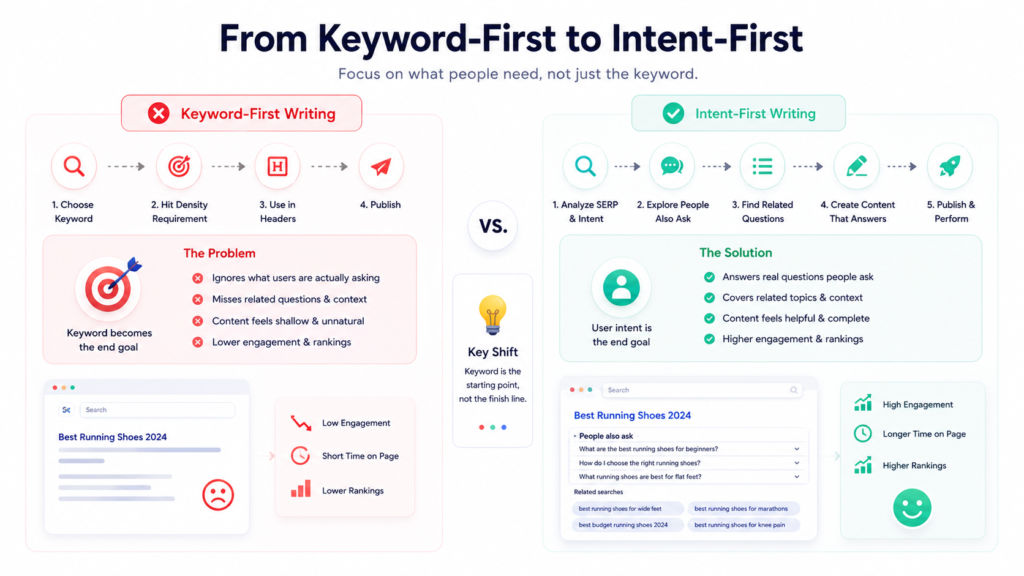
Keyword-first writing generally takes the following form: choose the phrase, reach the density requirement, use the keyword within headers, then publish. It may be seen as productive, since you have a checklist to go through. However, the problem here is that the keyword itself becomes your end goal rather than a starting point.
The solution is simple yet crucial: prior to writing anything, see what results you have for that keyword in the SERP, including the “People Also Ask” section and related searches. These are not SEO facts that you are supposed to know; these are actual questions that people ask. And you ignore them, only working on optimizing for the seed keyword, you miss the point of your keyword research.
A Simple Process for Checking Real Intent
- Search the keyword yourself and look at what actually ranks in the top 10 — note the format (list, guide, comparison), not just the topic.
- Read the “People Also Ask” questions and expand a few — they reveal the exact sub-intents people have.
- Scroll to related searches at the bottom of the page for adjacent phrasing and angles you might be missing.
- Match your content structure to what you find — if every top result is a step-by-step guide, a listicle probably won’t outrank them.
This isn’t a complex framework. It’s closer to a five-minute gut check. But that gut check is often the difference between content that ranks and content that doesn’t, regardless of how well it’s technically optimized.
How Search Intent Should Shape Your Content Optimization for SEO
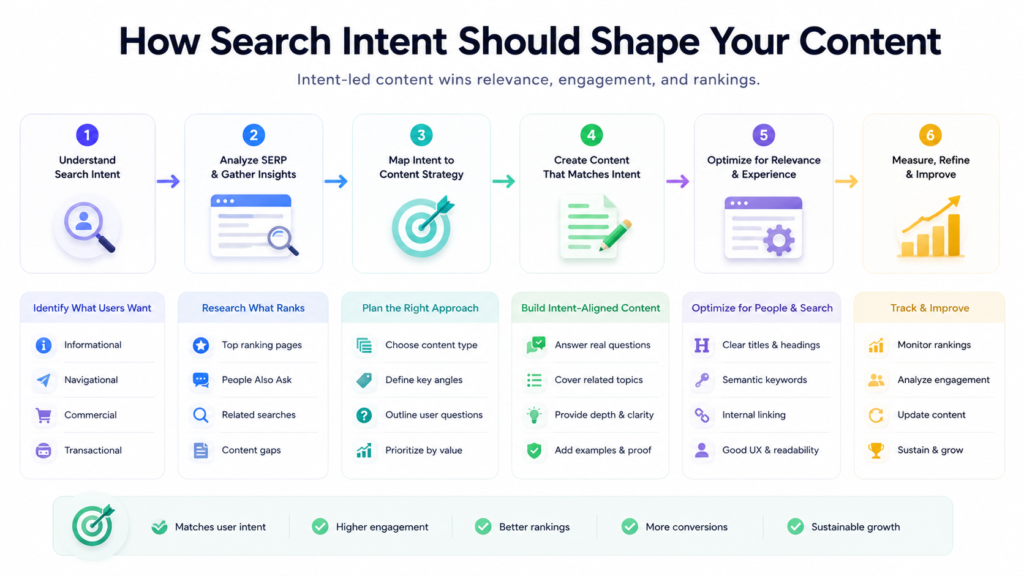
Once you know the intent, the rest of your optimization decisions get easier:
- Structure follows intent. Informational queries want clear headers and skimmable sections. Commercial queries want comparisons and criteria. Transactional queries want a clear next step, fast.
- Depth follows intent. If PAA questions show people want a step-by-step process, a surface-level overview will underperform even if it’s keyword-perfect.
- Tone follows intent. Someone comparing options wants confidence and clarity, not hedging; someone learning a new concept wants patience and plain language.
- Keyword placement stops feeling forced. When your content actually answers the intent, the primary keyword and its natural variations show up on their own, in the intro, a subheading, and the conclusion — without you having to force it in.
Common Search Intent Mistakes to Avoid
- Creating an extensive, technical article for a search term that just wants an easy answer.
- Designing a sales page for an informational keyword where users will leave as soon as they see what’s on offer.
- Going against the format that is already working well in the SERPs despite the good topic match.
- Using “People Also Ask” for research but ignoring it.
FAQs
Is it more important for SEO to consider search intent rather than keywords? It is no more important — but it is the priority to start with. While keywords inform about the searches made by people, intent informs about their motives. Keyword optimization should always be done by using the keyword to identify the intent and then write about the intent.
How do I uncover the search intent from a keyword? You should simply type the keyword into the search engine and analyze the top-ranking content formats and also study the “People Also Ask” and the related searches sections.
Is it possible to cover different search intents on the same page? Yes, but this approach may be hazardous. The pages that cover both a beginner who looks for an explanation and a purchaser at the same time usually fail to fulfill any of their tasks.
Conclusion: Intent First, Optimization Second
Content optimization for SEO isn’t about hitting a keyword density number — content optimization for SEO is about answering the real question a searcher has, in the format they expect. The fastest way to check that you’re doing it right is also the simplest: look at what’s already ranking, and read the questions people are asking around your topic before you write a single sentence.